The Real Cost of Context Switching: Why Your Team Can't Get Deep Work Done
Jan 17, 2026 • 8 min read
23 minutes.
That's how long it takes your brain to fully refocus after an interruption. Not 2 minutes. Not "just a second." Twenty-three minutes.
Now consider: How many times were you interrupted yesterday?
For the average knowledge worker, it's about 50-60 times per day. Do the math. You see the problem.
The Context Switching Crisis
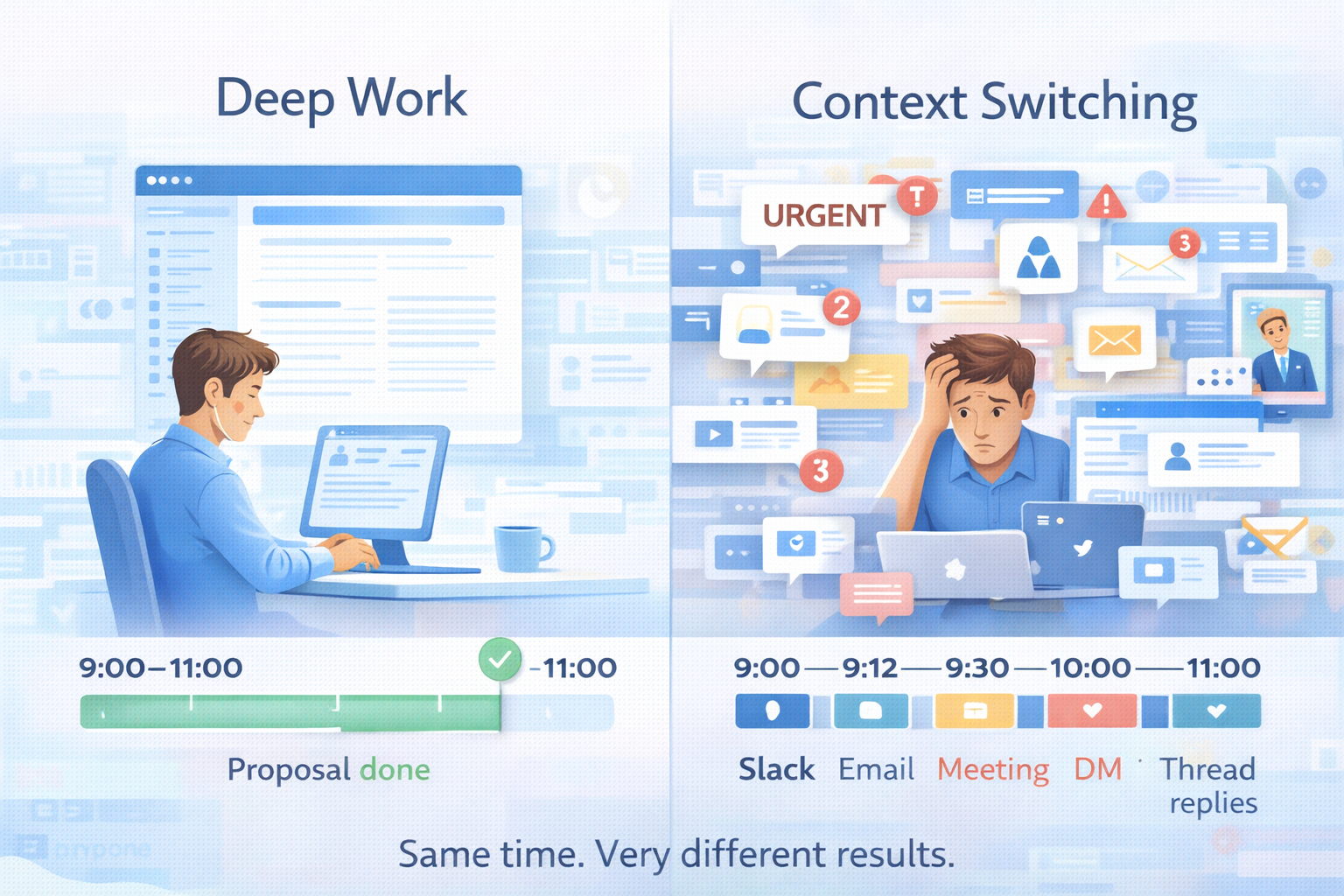
Here's what a typical workday actually looks like:
- 9:00 AM - Sit down to write that proposal
- 9:03 AM - Slack notification: "Quick question"
- 9:06 AM - Back to proposal... what was I writing?
- 9:12 AM - Email notification
- 9:14 AM - Back to proposal
- 9:18 AM - Someone stops by (or DMs)
- 9:25 AM - Calendar reminder: meeting in 5 min
- 9:30 AM - In meeting
- 10:00 AM - Out of meeting, back to proposal
- 10:04 AM - Three Slack messages came in during meeting
- 10:11 AM - Back to proposal... wait, what section was I on?
By 10:15 AM:
- 75 minutes elapsed
- Maybe 15 minutes of actual focused writing
- 6 context switches
- Proposal is nowhere near done
Multiply this across an 8-hour day. This is why you're exhausted but feel like you accomplished nothing.
The Science of Context Switching
Let's understand what's actually happening in your brain.
The Attention Residue Effect
Discovered by: Sophie Leroy, University of Minnesota
The finding: When you switch from Task A to Task B, your attention doesn't immediately follow.
What happens:
- You're working on Task A (writing code)
- You switch to Task B (respond to Slack)
- You return to Task A
- But: Part of your attention is still on Task B
This "attention residue" reduces your cognitive capacity by up to 40%. You're back at your code, but your brain is still partially thinking about that Slack conversation.
The Switching Cost Tax
Research from: American Psychological Association
The findings:
- Switching between tasks can cost 40% of your productive time
- Complex task switches (code → meeting → code) cost more than simple ones
- The more switches, the more errors you make
- Even brief mental blocks created by shifting between tasks can cost as much as 40% of someone's productive time
In dollars:
If you make $100,000/year and lose 40% to context switching:
- That's $40,000 of unproductive time
- For a team of 10: $400,000 annually
- For a 100-person company: $4,000,000 annually
The Cognitive Load Disaster
Your brain has limited working memory.
Think of it like RAM in a computer:
- Deep work: Uses 90% of your RAM for one complex task
- Context switch: Has to dump that RAM, load new task
- Switch back: Has to dump and reload original task
- Each reload: Incomplete, some data lost
After 5 switches: Your working memory is fragmented across 5 different contexts. None loaded fully. All competing for resources.
This is why you feel scattered.
How Slack Amplifies Context Switching
Slack isn't evil. But it's designed in ways that make context switching worse.
Problem #1: The Always-On Expectation
Email culture (old): Check a few times a day. Batch responses. Expectation: reply within 24 hours.
Slack culture (new): Always open. Real-time responses expected. Expectation: reply within 15 minutes.
Impact: You can't batch Slack like email. Each message is a context switch.
Problem #2: The Notification Treadmill
Every notification:
- Interrupts your focus
- Creates decision: respond now or later?
- Creates anxiety if you choose later
- Creates context switch if you choose now
Even if you don't respond: The interruption already happened. The 23-minute refocus clock restarted.
Problem #3: The Channel Chaos
Typical knowledge worker: Active in 20+ channels. Mentions in 5-10 channels daily. Direct messages from 8-12 people.
Each channel switch = context switch
Your brain has to: 1) Remember what this channel is about. 2) Load relevant context. 3) Understand the current conversation. 4) Formulate response. 5) Unload when you leave.
Multiply by 20 channels.
Problem #4: Thread Fragmentation
One conversation might span: A channel message. A thread with 8 replies. A follow-up DM. An emoji reaction that means... something? A separate channel where it continues.
Your brain: Trying to hold all these pieces together while also remembering what you were actually working on.
The Real Costs: Beyond Lost Time
Cost #1: Quality of Work Degrades
Deep work requires: Extended focus (2-4 hour blocks). Building complex mental models. Holding multiple variables in working memory. Creative problem-solving.
Context switching makes this impossible.
The result: Shallow work (responding to messages). Surface-level solutions (good enough, not great). Bugs and errors increase. Innovation suffers.
Example:
With deep work: Architect sees the whole system. Identifies elegant solution. Writes clean, maintainable code. Time: 4 hours.
With constant switching: Architect sees fragments of the system. Implements quick fix. Code is messy, hard to maintain. Time: 7 hours (+ future technical debt). You worked longer and produced worse results.
Cost #2: Decision Fatigue Compounds
Every Slack message creates micro-decisions: Do I respond now? Is this urgent? Can this wait? Should I read the full thread? Do I need to get involved?
Studies show: We have limited decision-making capacity per day.
After 50-60 of these micro-decisions: Your willpower is depleted. You make worse choices. You're more likely to just respond (even if you shouldn't). You're less likely to do hard, important work. This is why by 3 PM you're exhausted despite "just reading Slack all day."
Cost #3: Deep Work Becomes Impossible
Cal Newport's research: Deep work (focused, undistracted) produces: Higher quality output. Faster completion times. Greater satisfaction. Career-advancing skills.
But deep work requires: Minimum 90-minute blocks. Zero interruptions. Full cognitive capacity.
With constant Slack interruptions: You never reach deep work state. You're stuck in shallow work mode. Your most valuable skills atrophy. Your career advancement stalls.
Cost #4: Burnout Accelerates
The exhaustion isn't from the work. It's from the switching.
Your brain on constant context switches: Elevated cortisol (stress hormone). Reduced ability to focus. Anxiety about incomplete tasks. Feeling "always behind." Never feeling accomplished.
After months of this: Burnout. Not because you're working too hard, but because you're switching too much.
What High-Performing Teams Do Differently
I studied teams that maintain deep work despite using Slack. Here's what they do:
Strategy #1: Designated Focus Blocks
The system:
- 9 AM - 12 PM: Deep work time (Slack closed)
- 12 PM - 1 PM: Collaborative time (Slack open)
- 1 PM - 3 PM: Deep work time (Slack closed)
- 3 PM - 5 PM: Communication time (Slack, meetings)
Team norms: No expectation of Slack responses during focus blocks. Meetings only in collaborative windows. True emergencies: phone call, not Slack.
Result: 6 hours/day of deep work possible. Batched communication is more efficient. Team knows when people are available.
Strategy #2: The Priority Filter
The problem: Everything feels urgent in Slack. The solution: Make senders prioritize.
How it works: When someone messages you, they choose: 🔴 URGENT - needs response within 2 hours. 🟡 NORMAL - needs response today. 🟢 LOW - respond when you can.
What this does: Senders think twice ("Is this actually urgent?"). 80% of messages get tagged LOW. You can safely ignore LOW during focus time. URGENT actually means urgent.
Implementation: Team agreement on what each level means. Accountability: if you tag URGENT for non-urgent, you lose credibility. Tools like Slackoff can enforce this automatically for leave management.
Strategy #3: The Batch System
Instead of: Checking Slack constantly. Do this: Check at scheduled intervals.
High-performing schedule:
- 9:00 AM - Quick scan (5 min)
- 12:00 PM - Full check + responses (30 min)
- 3:00 PM - Quick scan (5 min)
- 5:00 PM - Final check + cleanup (30 min)
Total Slack time: 70 minutes. Context switches: 4 (down from 60). Deep work blocks: 3 solid blocks.
The key: Team alignment on response time expectations.
Strategy #4: The Escalation Ladder
Not everything belongs in Slack.
The hierarchy: 1) Slack - Quick questions, FYIs, async updates. 2) Huddle/Call - Complex discussions needing back-and-forth. 3) Meeting - Decisions requiring multiple stakeholders. 4) Document - Anything that needs to be referenced later.
The rule: If a Slack thread hits 15+ messages, it should have been a call.
Result: Less time in fragmented Slack threads, more efficient communication.
Strategy #5: Coverage Systems
The pattern: High performers can actually disconnect.
How: Before deep work: Set status "In focus mode until 3 PM." Before vacation: Clear POC for urgent issues. Use auto-responses: "I'm in focus time. For urgent matters, contact @backup."
Tools that help: Slack DND scheduling. Status automations. Leave management tools (like Slackoff for vacation coverage).
Result: Permission to focus without guilt.
How to Measure Your Context Switching
You can't fix what you don't measure.
Method 1: The Interruption Log
For one day, track every time you're interrupted. Track: Time. Source (Slack, email, person, etc.). Duration of interruption. Time to refocus.
Example log: 9:15 AM - Slack notification - 3 min - 20 min refocus. 9:42 AM - Email alert - 2 min - 15 min refocus. 10:08 AM - Colleague question - 5 min - 25 min refocus.
After one day: You'll be horrified. That's good. Now you have data.
Method 2: The Focus Block Test
Day 1 (baseline): Work normally. Note: How much deep work you accomplished. How you felt at end of day.
Day 2 (focus blocks): 9 AM - 12 PM: Slack closed, phone on DND, focus on ONE thing. Track what you accomplished.
Compare: Most people report: 3-4x more output in focused time. Higher quality work. Less exhaustion. "I forgot this is what it feels like to actually think."
Method 3: RescueTime or Similar
Automatic tracking tools show you: Time spent in each app. How often you switch. Your most distracting apps. Patterns (worst switching times). Warning: The data is often worse than you think.
The Action Plan: Reducing Context Switching
Week 1: Individual Changes
Monday: 1) Close Slack during your first 2 hours. 2) Track interruptions in a notebook. 3) Notice how it feels.
Tuesday: 1) Set up Slack notification schedule (9 AM - 6 PM only). 2) Turn off all email notifications. 3) Check both at set times (9 AM, 12 PM, 3 PM, 5 PM).
Wednesday: 1) Set up DND blocks in calendar (for deep work). 2) Put phone in another room. 3) Work on ONE thing for 2 hours.
Thursday: 1) Review your interruption log. 2) Identify biggest sources. 3) Plan how to eliminate top 3.
Friday: 1) Implement one permanent change. 2) Communicate it to your team. 3) Measure the difference.
Week 2: Team Changes
Get your team to agree on:
- Response time expectations - Normal messages: 24 hours is fine. Urgent messages: must be tagged URGENT.
- Focus time blocks - Mornings = deep work. No meeting before 11 AM. Respect DND status.
- Meeting hygiene - Default to async first. Meetings require agenda. No meetings Friday.
- Channel cleanup - Archive dead channels. Clear purpose for each channel. Reduce overlap.
Week 3: System Changes
Implement tools/processes:
- Priority tagging system - All messages tagged: URGENT, NORMAL, FYI. Team accountability.
- Leave coverage - Before leave: assign backup. During leave: auto-responses with backup info. After leave: prioritized summary (not 73 notifications).
- Documentation culture - Common questions → docs. Decisions → docs. Slack → ephemeral only.
- Async-first defaults - Voice memos instead of calls. Loom videos instead of meetings. Written updates instead of syncs.
Week 4: Measurement
Track improvements: Interruptions per day (should drop 60-80%). Deep work hours (should increase 3-5x). Team satisfaction (survey). Output quality (self-assessment). Iterate based on data.
The Tools That Actually Help
Most tools make context switching worse. Here's what actually helps:
For Individual Focus:
- Freedom / Cold Turkey Blocker - Block Slack during focus time. Schedule automatic blocks. Can't cheat (even if you want to).
- Focus@Will / Brain.fm - Music designed for focus. Signals to your brain: "We're working now."
- Pomodoro apps - Forces you to batch work. Builds focus stamina.
For Team Communication:
- Slack Settings (properly configured) - Notification schedules. DND automations. Keyword-only notifications.
- Loom - Record explanations instead of typing. Async video > real-time meetings. Reduces back-and-forth Slack.
- Slackoff (for leave management) - Auto-responses when you're unavailable. Priority tagging for incoming messages. Clean summary on return. Solves the "vacation chaos" context switch.
For Documentation:
- Notion / Confluence - Gets information out of Slack. Single source of truth. Searchable, referenceable.
The key: Tools don't fix culture. But they can enforce good culture.
Case Study: Engineering Team at 50-Person Startup
Before (January 2025): Engineers reported constant interruptions. Average focus block: 15 minutes. Deploy frequency: 2x/week. Bug rate: High. Team satisfaction: 4/10. Burnout complaints: Weekly.
Changes implemented: 1) No-meeting mornings (9 AM - 12 PM). 2) Slack DND during focus blocks. 3) Priority tagging system (URGENT vs NORMAL). 4) Leave coverage system (Slackoff). 5) Async standups (no daily sync meetings).
After (March 2025): Average focus block: 2.5 hours. Deploy frequency: 5x/week. Bug rate: Down 40%. Team satisfaction: 8/10. Burnout complaints: Rare.
"We didn't work more hours. We just stopped switching contexts every 6 minutes. Output quality went up, stress went down, people actually enjoy work again."
Cost: $0 (just process changes + one $99 tool). ROI: Massive.
The Hard Truth
You probably can't eliminate context switching entirely. Some is necessary. Some is the nature of collaborative work.
But here's what you can do: Reduce it from 60 switches/day to 10. That's an 83% reduction.
That means:
- Instead of 60 × 23 minutes of refocus time (1,380 min = 23 hours)
- You have 10 × 23 minutes (230 min = 3.8 hours)
You just recovered 19+ hours of cognitive capacity. In a 40-hour work week, that's transformative.
The Bottom Line
Context switching is killing your productivity. Not Slack specifically. Not remote work. Not your job. Context switching.
The average knowledge worker:
- Switches contexts 50-60 times per day
- Loses 40% of productive time to switching
- Produces lower quality work
- Feels exhausted despite accomplishing little
But this is fixable:
Individual level: Close Slack during focus blocks. Batch communication. Use DND liberally. Track your interruptions.
Team level: Establish focus time norms. Implement priority tagging. Respect deep work. Coverage systems for unavailability.
Company level: Measure context switching as a KPI. Default to async-first. Limit synchronous demands. Build systems that protect focus.
The cost of fixing this: Minimal. The cost of ignoring it: $4M annually for a 100-person company.
Start today. Pick one change. Implement it. Measure the difference. Your future focused self will thank you.
If you're losing focus time to "return from vacation chaos," check out Slackoff - it gives you back 1-2 hours per leave return by prioritizing messages automatically.
Try Slackoff →